
Table of Contents
- Introduction: Why an Old Exchange Still Matters to New-Age Investors
- The Birth of the Calcutta Stock Exchange
- From a Neem Tree to Lyons Range: The Early Years
- The Golden Era: Calcutta’s Rise as a Financial Capital
- The Decline: Regulation, Competition, and the 2013 Suspension
- Where Things Stand Today: Revival Talks and SEBI’s Review
- Why This Story Matters for Unlisted Shares in India
- How Regional Exchange Shifts Connect to the Unlisted Market Today
- Featured Snippet: What Is the Calcutta Stock Exchange, in Short?
- FAQs
Why an Old Exchange Still Matters to New-Age Investors
Lyons Range in Kolkata, an Indian Capital street, one of the first stock exchanges in India, was a lot more influential than NSE and BSE put together in the early days of capital markets.
The Calcutta Stock Exchange (CSE) is one of the oldest Stock Exchanges in Asia, and its transformation from a Colonial era trading post to an institution that has gone bust and is trying to revive itself explains the transformation of the Indian Capital markets from its Colonial beginnings.
CSE’s history is not irrelevant for modern-day unlisted stocks, as it shows how the market, consumer regulations, and infrastructure for listed and unlisted shares change. CSE’s history shows how today, platforms for unlisted shares can fill the insertion gaps that CSE’s platform once provided.
For a long-term vision for the unlisted share market in India and pre-IPOs, CSE’s history provides good insights and context.
The Birth of the Calcutta Stock Exchange
Trading securities in an organized format in Kolkata has a longer history than many may believe. The first instance of security dealing in recorded history came from the trading of British East India Company loan stock, and by 1830, informal bourse activity in Kolkata was taking place under a neem tree in what is the business district of present-day Kolkata.
The later decades of the 1800s saw the first formal trading structures being established.
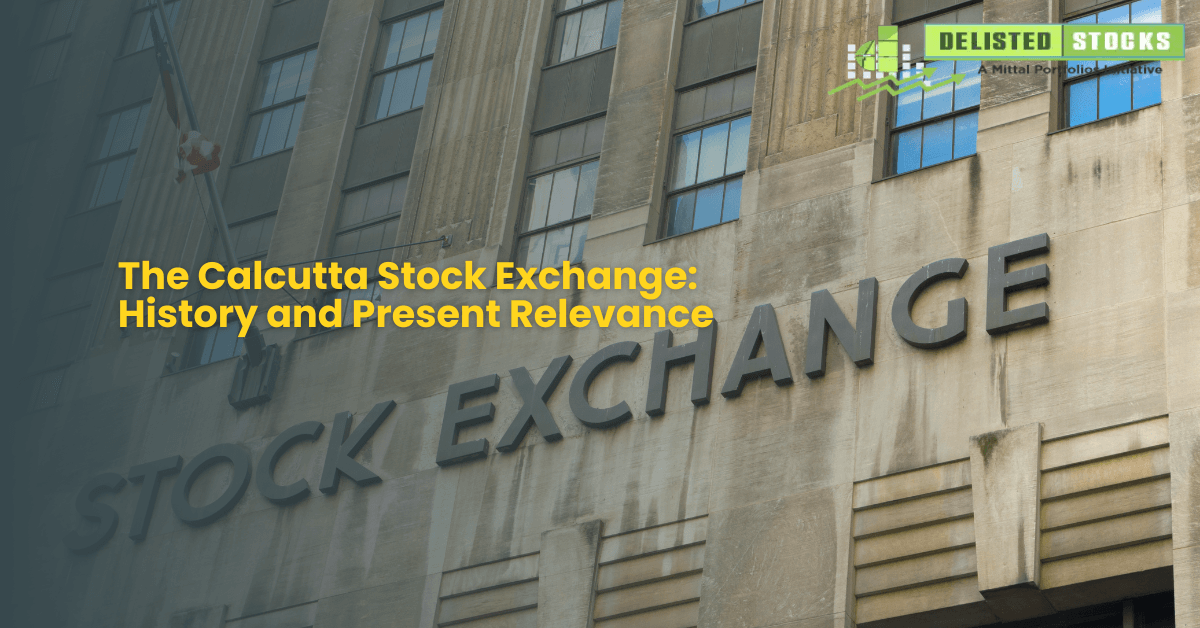
On December 1, 1863, the Calcutta Stock Exchange came into being after 16 stock brokers took the initiative to open the Exchange in Strand Road.
Interestingly, the early stock exchange rooms also served as a public library. There was a small entry fee to use the library, which indicates the strong connection that finance and the civic life of Kolkata had during the 19th century.
From a Neem Tree to Lyons Range: The Early Years
For several decades, the exchange continued to operate in an informal manner and then underwent a major reconstitution in 1908 when it was re-established in its current form at 2, China Bazar Street, and many of its present-day members (about 150) signed up.
Because of this, 1908 is usually taken to be the “official” founding year of the exchange, and this is also one of the reasons the Calcutta Stock Exchange (CSE) is referred to as being more than a century old.
In the years that followed, a complete range of services offered by the stock broking community, listed companies, and clearing entities was established, and the exchange completed its infrastructure and functional ecosystem.
Additionally, it became synonymous with Lyons Range, which is the focal point of the eastern Indian capital market.
The Golden Era: Calcutta’s Rise as a Financial Capital
At its height, Calcutta’s bourse was thought to be India’s second-largest after the Bombay Stock Exchange. Numerous reports from experienced traders say the exchange was swamped at times with thousands of listings.
At that time, Kolkata was one of the top commercial and industrial hubs in India, and the exchange was a testament to its position in jute and tea, along with manufacturing from eastern India, which directed its capital raising efforts at Lyons Range.
This period is what gives the CSE its symbolic legacy. It was not a marginal player; for a time in the 20th century, it was a player that could seriously be compared to Bombay in terms of scale and impact.
The Decline: Regulation, Competition, and the 2013 Suspension
The establishment of interconnected electronic trading was the tipping point. With the introduction of screen-based, pan-India trading at the National Stock Exchange and a more modernized Bombay Stock Exchange, regional Stock Exchanges like Calcutta could not keep up.
The most important factor of any stock exchange, liquidity, began to shift to the stock exchanges that could offer quick trade and a broader base.
Regulatory tightening combined with pressure. SEBI established new standards for exchanges, including the presence of an independent clearing corporation to guarantee settlement of trades, in addition to new governance and net-worth standards.
The CSE could not fulfill these requirements, and in April 2013, SEBI suspended trading on the C-STAR platform. This suspension was upheld by the Calcutta High Court after the exchange challenged it in court.
The exchange has remained inactive since this suspension. In the following years, more than a dozen other regional exchanges, including Bangalore, Hyderabad, and Madras, ceased operations under SEBI’s exit policy for exchanges, which could no longer meet the operating criteria.
The CSE now stands as a monument to regional exchanges for the greater consolidation of India.
What lies ahead
In 2025, the CSE filed a new application with SEBI for a voluntary delisting of the exchange (a full exit application instead of a dormant status). SEBI has formed a new work group and appointed a valuation firm to assess the exchange’s assets and liabilities, pending a decision, and government officials have confirmed to Parliament that the application is under active consideration.
At the same time, a divergent story has come to the fore. West Bengal’s 2026-27 state budget revived a proposal to reopen the Exchange to restore Kolkata’s Financial Hub status.
Any attempt to revive the Exchange in the future would face the same challenges that led to its original collapse. These challenges include the existence of national exchanges with deep liquidity, increased SEBI regulations, and greater challenges in obtaining trade and liquidity for a once-defunct exchange after more than a ten-year period of inactivity.
Although the CSE either has to exit gracefully or attempt a small-scale revival, possibly focusing on financing MSMEs or trade-specific regional corporate listings, it is clear that the next few months will provide much more regulatory guidance.
Why This Story Matters for Unlisted Shares in India
This is the important connection for investors and researchers tracking India’s private capital markets. When a formal exchange either loses its marketplace or completely withdraws from the trading scene, the companies and instruments linked to that exchange do not vanish.
All of the trading participants still own equity stakes that require Transacting, and that is the void that the unlisted securities market has stepped in to address.
India’s evolving unlisted market has moved beyond being a specialized area for employee stock options and pre-IPO speculation. It has developed into a bona fide secondary market for companies that are either candidates for a public offering, have delisted from the formal stock exchanges, or have yet to make a decision to list.
The CSE’s decline from a successful regional exchange to a defunct institution seeking an exit has also been instructive, as centralized, liquid, and well-regulated unlisted share transaction frameworks have been demanded by Indian investors.
How Regional Exchange Shifts Connect to the Unlisted Share Market Today
India’s exchange consolidation has not only impacted regional exchanges; it has also changed the dynamics of supply and demand within the unlisted market as a whole.
The concentration of formal listing pipelines has worked to centralize most of the major exchanges, consequently increasing demand for unlisted shares within the NSE, since the NSE has been one of the most publicized Pre-IPO companies.
In addition to the NSE, several other exchange-related unlisted opportunities have garnered attention. The MSEI unlisted share segment illustrates that even exchanges that have not reached NSE’s trading volumes still engage the interest of investors for their pre-listing equities.
Analyzing the NSE unlisted shares, MSEI unlisted shares, and NCDEX unlisted shares provides insight into the behavior of unlisted shares of exchange-related equities as opposed to the shares of consumer or novel companies.
Other things besides just stock exchanges create this kind of interest. New-age companies adjusting their business attributes for expected public listing (from hospitality platforms to quick commerce players), create active trading in the unlisted space before formal IPO filings.
This is why platforms following OYO unlisted share activities and Zepto unlisted shares are now popular resources for investors to anticipate the pre-IPO sentiment in various industries.
The CSE’s history provides a clear connection to all of this. As the consolidation of India’s capital markets gained pace, the demand for reliable and documented unlisted share platforms has grown.
There were limited unlisted trading options in the past generation when the Calcutta exchange handled a greater portion of India’s capital market activities.
What Is the Calcutta Stock Exchange, in Short?
Founded in 1863, the Calcutta Stock Exchange is one of the oldest stock exchanges in Asia. Once India’s second-largest bourse, it has been inactive since SEBI suspended its trading platform in April 2013. As of 2026, the exchange has applied for a voluntary exit from SEBI’s recognized-exchange framework, even as a state government proposal explores its potential revival.
FAQs
When was the Calcutta Stock Exchange founded?
The CSE was founded on 1 December 1863 by sixteen stockbrokers and was later reconstituted in its current form in 1908.
Is the Calcutta Stock Exchange operational?
No. Trading at the CSE has been inactive since April 2013. SEBI enforced a suspension of its trading system, C-STAR, because of regulatory oversight issues.
Why is the Calcutta Stock Exchange closed?
CSE failed to comply with SEBI’s standards, including the establishment of an independent clearing house and the adherence to governance and net-worth requirements, in addition to the loss of trading activity to national electronic exchanges (NSE and BSE).
Is there a possibility of the Calcutta Stock Exchange’s reopening?
Revival of CSE is estimated in the 2026-27 budget of West Bengal. However, this coincides with the exchange’s own application to SEBI for voluntary Closure. The decision will be made based on the assessment of SEBI.
Why is the history of the Calcutta Stock Exchange important concerning unlisted shares?
With the decline of regional exchanges, like CSE, unlisted share platforms have become the primary method for investors to gain access to pre-IPO trading, unexchanged equity, and non-exchange trading, as well as shares tied to regional exchanges and equity of modern private enterprises.
How can I find unlisted shares of NSE and MSEI exchanges?
Researching unlisted shares will have individual tracking pages of unlisted share activity for NSE and MSEI, along with the overall demand and supply of NSE shares, MSEI, and NCDEX.
Disclaimer:
This article is for information and educational purposes only. It is not investment advice, a recommendation, or a solicitation to buy or sell any security. Please do your own research and consult a financial advisor before making any investments.